I know I’ve been too busy to post anything here for a while now, but I came across something recently that I found so cool that I had to share it. Usual disclaimer: This is a very handwavey explanation.
Most people think of black holes as “a thing that nothing can escape from, not even light”. And this is correct, modulo some quantum stuff. You also may know that general relativity tells us that the gravitational force is actually a warping of space-time itself, and that at the centre of a black hole the spacetime is so curved that it becomes singular.

Obviously you’ve spotted the contradiction to Fermat’s last theorem there too, right?
A curvature singularity is thought of like the hole in ground in the above image from Homer’s trip into 3D land; it becomes infinitely curved. It is generally assumed that inside a black hole there is always one of these singularities, and in fact the standard picture of gravitational collapse tells us that this should always be the case.
However, some recent work by Prof. Dr. Frans Klinkhamer from the Institute for Theoretical Physics at Karlsruhe Institute of Technology has come up with some unusual solutions to Einstein’s equations corresponding to black holes without singularities. Now this in itself is not entirely new, because people have found similar solutions by inserting some weird “exotic matter” into their models. However Klinkhamer has come up with solutions to Einstein’s equations corresponding to black holes without singularities, without introducing weird matter. In fact, these solutions have NO matter in them; they’re entirely empty universes.
There is however something peculiar about his universes, which allows for these black holes. The difference is in what mathematicians call the topology of the universe. Inside the event horizon, the universe twists around itself; not entirely unlike a pretzel.
As I mentioned above, this kind of black hole is a perfectly valid solution to Einstein’s equations but it doesn’t agree with the standard picture of gravitational collapse. There is no proposed mechanism for this weird twisting of the universe to occur naturally from the gravitational collapse of a massive object, and in fact there are theorems saying that when gravitational collapse occurs the end result is actually a singularity. But who knows? Perhaps when we have a working theory of quantum gravity, we will come up with a mechanism to avoid the singularity and end up with one of these solutions instead. Or perhaps this is just a mathematical quirk and nothing more?
The most recent paper on this stuff can be found here (not for the faint of heart): http://arxiv.org/pdf/1304.2305.pdf
I’ve been a terrible blogger lately, and I promise I’ll get back to it soon. In the meanwhile though, I’ve been getting regular hits to this page so I thought I’d leave the most recent post as a list of some of the more popular posts. You’ll be able to tell which ones people got to by accident, looking for something entirely different, but I’ll leave them in.
Feel free to leave some comments too; comments might help encourage me to get back to blogging 🙂
An oft-quoted line from teacher to student is “There is no such thing as a stupid question”, which I think is a good sentiment to alleviate the fear of asking questions. Although I believe a good deal more than that is required to ensure that students are comfortable asking and answering questions in class, this is not what I plan on talking about today.
Today we’re going to talk about a special kind of stupid question. Of course there are stupid questions; Why did you lock your keys in the car? Would you like free upgrade to first class? What’s your star sign? Should I go to grad school? What’s that smell? And many more… Then there are things like these beauties from the Australian Academy of Science. But if you’re observationally gifted, you may have noticed that this post was filed under education. Today we complain about education again.
Far too often, I’ve seen test questions that I don’t remotely agree with. I don’t disagree with the solutions — I just don’t believe that the questions achieve their purposes. Since I’m not nearly at a point in my career when I can carelessly insult specific questions that I’ve come across, I won’t. But this kind of stupid question is so prevalent that it wouldn’t be fair to isolate any particular culprits anyway. The kind of stupid question that I’m talking about is one requiring unnecessary complicated calculations or assuming that the student is familiar with some particular example. And here I’m referring to test questions only — timed tests should be approached differently to assignments, where plenty of unstressed thinking time is available. Let me illustrate what I mean with some fictional examples:
- Testing l’Hôpital’s rule with an example that requires 6 iterations before getting an answer. That is, the student must perform the same technique 6 times over before arriving at an answer.
- Testing primary school geometry by asking what the interior angles of a stop sign are. Not knowing the shape of a stop sign is different to not knowing what an octagon is.
- A separable first order ODE that requires a page of working to evaluate the integral.
- Asking students to reproduce a proof that was included as an optional exercise earlier in the semester. Students will do a different random selection of problems each; you’ll just be measuring which students picked the same question that you did.
- Having a needlessly ugly solution to a problem — Like
. Many students will assume it’s wrong and either start again or abandon the problem entirely.

Credit to this dude, who has a page full of these drawings.
These problems don’t only cause students who understand the concepts to get the questions wrong, they can also make students waste time and become unnecessarily stressed. And just to reiterate the point, I think these are terrible test questions but perfectly good assignment questions. Test questions should test concepts, not who was listening to the example given in lecture 17 or who can perform pages of computations the fastest.
\end{gripe}
Dear readers,
sorry for being such a useless blogger lately. I started off posting as often as a few times a week and now it’s been over a month since my last post! It could be the three distinct talks that I’ve had to give recently, or that my PhD is reaching crunch time, or the fact that I now have a girlfriend; somehow I’ve not found the time to blog though. As I’m currently visiting a GR program at MSRI and staying in a house in Berkeley Hills, away from distractions, I can type up a post I had sitting in the ideas pile.
Pick a number – any number…
What did you pick? Was it 7? Or pi? or 
Let me explain.
The random number can – and will be – arbitrarily large so it will have many many digits. If I had a 100 digit number then the probability that the first digit is not a 7 is 9/10, the same for the second digit and the same for the rest. So the probability that none of the digits are 7 is given by the product of the individual probabilities — 
Alternatively, you could consider how many numbers less than 10 have a 7; then how many less than 100 have a 7, etc. and you would see that this ratio approaches 1 as you start including higher and higher numbers.
Then again, does it even make sense to “pick a random number”?
It seems I’ve been way too busy lately to actually post anything here, so today we’ve got a guest post from David Hartley.
With Australia making it back into the world group of the Davis Cup after six years and Steve taking the week (month?) off, I thought this would be a great opportunity to write a guest blog. Now I will try to keep this in the same vein as Steve’s blogs but I suspect I won’t be able to stop myself including some equations (the worst ones I will provide links to instead of including in the text).
As a mathematician and sportsfan I often find myself checking out various statistics (for example F1 sector and lap differentials) and trying to predict what will happen and the end of the match/race. One of the most interesting sets I’ve found are tennis statistics, especially since you can win more points than another player but still lose in straight sets. And because most games end with only slightly different amounts of points won but again are over in straight sets. In this blog we will see why this is so.
A while ago (nine and a half years apparently) I came across a maths question in an interesting probability book. It asked: If the probability of you winning a point is 
Firstly 

The next best way to win a game of tennis is by winning a point after being up 40-15 (or 3-1 if tennis had a sensible scoring system). This sort of game can occur four ways, since your opponent can win their point on the first, second, third or fourth points of the game (this is often written as the binomial coefficient 


Likewise to win a game to 30 the probability is 
So far, so good but what happens next? You can’t win from 40-40, instead you would need to win the next two points. Therefore the probability of winning is 
(s) (Note to editor: go to hell Steve it’s maths!).
We know that the probability of getting to deuce is 


This can be solved for

With that little trick of algebra the problem is solved and the probability of you winning the game is:

To get a feel for the formula assume you win 55% points on average against another player (a relatively small difference considering a tight set might have around 60 points), then the probability they win a game is 62.3%. A steep increase indeed (the slope has a maximum value of 2.5 when 

The probability curve for winning a game of tennis. Sexy, huh?
The situation gets worse if you consider a set of tennis. For this we need some extra formulas such as those for the probability of winning a tie-break and both tie-break set and advantage set. The probability curves for an advantage set (Figure 2) shows that if you have a 55% chance of winning a point, you get a 82% chance of winning the set. Remember if there are 60 points in the set that means on average the points won would be 33-27.

The probability curve for winning an advantage set. Mmmmm Matlab.
The curves for the probability of winning a match can also be done and they show that for a five set match where the last set goes to advantage, a person who wins 55% of points has over a 95% chance of winning the match.

The probability curve for winning a five set advantage match. Wowwee, don’t bother showing up unless you win more than a third of the points on average.
Of course this analysis is very simplified. For instance if anyone remembers Wayne Arthurs then they will know that the probability you win a point on serve, 73% for Arthurs in 1999 leading to 91% of service games won (our model gives 93%), can be vastly different to the probability you win a point while receiving, 29% in the same year with 8% of receiving games won (8.8% by the model). Including both parameters will change the formulas for the probability of winning a tie-break game or either type of set; since mathematically it makes no difference if you serve first or second in the set, the match formulas don’t change. Using those formulas the data tells us he had a ~59% chance of winning; his actual winning percentage that year was 51% (he only played 27 matches so the data set is small). However, the moral of the story is that even if your favourite player has a scoreline that looks like they were easily beaten, this may just be a result of compounding probabilities.
You may see this title and immediately think that this is the second part of a two part post; you’d be wrong. This title is an example where intuition can be wrong — or an example of sneaky buggery. Or something? This is to prepare you for a little probability problem. At first, probability sounds like it must be the most intuitive thing ever; if something happens 50% of the time then there’s a good chance that it will happen in around 50 of 100 trials. But it turns out that probability can actually be quite the sneaky bugger. We’ve already seen the Monty Hall problem here, which seemed like quite a simple little probability problem but turned out to be quite counter-intuitive. Today we’ll look at another little probability paradox* that I was recently reminded of.

*Not actually a paradox.
First let’s look at a simple problem.
Mrs Robinson — here’s to her — has two children; at least one of whom is a son. What’s the probability that she has two sons?
How stupidly simple does this problem sound? It’s about 50%, right… We know that one of them is a son, so the other one has a 50-50 chance?
Of course not! Probability is far too sneaky for that.
Since we know that she’s got at least one son, there are three possibilities:
- She has two sons,
- The older sibling is a son while the younger is a daughter,
- Or the older is a daughter while the younger is a son.
We’re assuming here that they weren’t at the the exact same time, but this is only so that I can easily talk about the different scenarios. You can convince yourself that these outcomes are equally likely by considering the 4th possibility; if we didn’t know about one of her sons then she could have two daughters. These 4 outcomes are clearly equally likely before we have any knowledge of a son. By saying that at least one is indeed a son, all we’ve done is rule out the fourth option.
Since there are three equally likely outcomes, there is a one in three chance that she has two sons! Take that, intuition!
So now let’s change the problem ever so slightly.
Mrs Robinson has two children; at least one of whom is a son who was born on a Tuesday. What’s the probability that she has two sons?
Oh get stuffed! What does Tuesday have to do with anything? These are probably things that you’re thinking to yourself. The answer is obviously the same as before… right… isn’t it?
Ha! Probability and it’s swift kick to the brainbits strikes again.
Let’s write down all of the (equally likely) possible cases again:
- The older is a son born on a Tuesday and the younger is a daughter.
- The older is a son born on a Tuesday and the younger is a son born on a Wednesday.
- The older is a son born on a Thursday and the younger is a son born on a Tuesday.
- The older is a son born on Tuesday and the younger is a son born on a Thursday.
- … There appears to be a whole lot of other possibilities in this scenario.
The difference here, is that we are being more specific about the boy now. If we had said “This is Johnny, Mrs Robinson’s son; he’s got one sibling.” then it would be obvious that there was a 50-50 chance of his sibling being a brother. The more specific we are about her son, the closer the probability gets to a 50-50. If we add up all of the cases in the Tuesday example, we’d actually find that there is a 13/27 chance of Mrs Robinson having two sons.
Convince yourself! Write up a table of the possibilities and check it out.
Watching Robin Williams talk about poetry in Dead Poets Society reminded me of A Mathematician’s Lament by Paul Lockhart — yes, I have already linked to this once before. I want to make all pure maths students watch it, and replace “poetry” with “mathematics” throughout.
Rigour and structure are extremely important in mathematics, particularly so in pure mathematics. This however, does not mean that one should learn these things first; you need to have an appreciation for it. Schools all over the world teach students trigonometry; the sine of any angle in a right-angled triangle is equal to the length of the opposite side divided by the length of the hypotenuse. Are the people in charge of the curriculum under some deluded idea that this is what mathematics is all about? Or do they think that this is somehow “useful math” for the real world?
Instead of teaching students how to compute angles and lengths by plugging it into the same formula over and over again, we only need to teach them that it’s possible. We should start students with the old “compass and straight edge” problems; something akin to a puzzle. These kinds of problems are more in line with what mathematics is really all about, and then learning basic trigonometry afterwards wouldn’t just feel like rote. Or am I being too optimistic here?
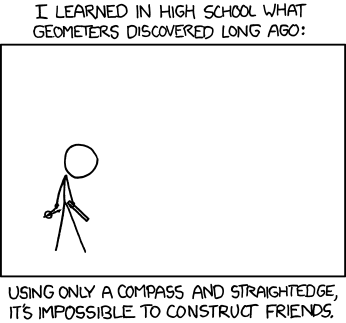
From XKCD (Obviously)
Last week, I went to the State Library of Victoria for the first time. There I found a ~500 year old copy of a book, which is second only to the Bible in the number of editions published. Euclid’s Elements is almost certainly the most influential mathematical text ever, so it’s only fitting that Euclid be our first dead mathematician. Thankfully copyright ran out 2 millennia ago — because copyright was a thing then, right? You can read it for free from Google here. Go forth and learn the basic building blocks of geometry as it should be taught!
Update: There is a great online version of the Elements here, with some awesome interactive java applets. Thanks to Mat for linking it in the comments!
It’s amazing how many of us understand the basics of quantum mechanics and general relativity, but still get tripped up by seemingly simple things. I’ve mentioned in the past that we’re still not entirely certain why a bicycle stays upright, which I think it pretty spectacular; we can put a man on the moon, but a bicycle thwarts us.
Recently I posted about a particularly nifty way to cool beer and I couldn’t be certain of the exact mechanism. Recently I had a good opportunity to use this method when I was having some knock-off beers with a bunch of physics PhD students, so I asked them to speculate on the mechanism too. It wasn’t immediately obvious to anybody there and even after the ensuing discussion, there still seemed to be some uncertainty. I think I’m pretty convinced now that it’s mainly evaporative cooling now though. (Although I’m yet to demonstrate this by experiment.)
So anyway, the point of this post wasn’t to talk about all that again. As a PhD student, Feynman and his fellow students found a problem in a hydrodynamics textbook that caused a bit of a stir. In fact after the students got nowhere with it, they took it to Feynman’s doctoral advisor, John Wheeler — who is a pretty damn big-shot himself — and even he didn’t have an answer for them. So what is it that thwarted some of the greatest minds of modern times? A sprinkler. A god-damn sprinkler.

“Physics is my bitch”
Image credit: A. Jude
Imagine a simple sprinkler; so simple that it’s easier to show you a picture than to actually describe it.

The curly bits are rigid.
Hopefully it is obvious that this will start spinning clockwise (as viewed from above) when we turn it on. What if some idiot neighbour kid decides to kick the sprinkler in the pool? Well obviously we go outside and beat that kid up for intervening with science. But what about the sprinkler? Will the sprinkler still keep rotating if it’s under water? Hopefully it is still obvious that the sprinkler will still keep rotating, just as before. This isn’t any different to having the sprinkler still above water but blowing air out instead; it will still propel itself around.
But now for the tricky part; the part that stumped the big-wigs. What if the direction of the water flow is reversed? Imagine that instead of blowing water out of the sprinkler, it sucked it in. If it helps, imagine that you stole the neighbour’s vacuum cleaner — apparently they had it coming — and you connected the vacuum to the sprinkler, where the hose goes in. We use the neighbour’s vacuum because the vacuum isn’t recovering from this. But the point is, the water is now flowing into the sprinkler instead of gushing out of it.
So which way does the reverse sprinkler rotate? Does it keep rotating the same way, or does it change direction? When the physicists discussed this, they all thought the answer was immediately obvious; half of them said it obviously goes the same way, while the other half said it changes direction.
One half: The ingoing water pushes the sprinkler arms in the direction that the water is flowing in, causing it to continue to rotate clockwise.
Other half: The entering water causes a suction effect where they water enters the sprinkler arms, causing it to rotate anticlockwise.
Since there was so much confusion, Feynman and his fellow students did the only reasonable thing they could do; they built a reverse sprinkler using equipment in a lab at Princeton. And like all good scientists, they conclusively established which way it would rotate and patted each other on the back for a job well done… Oh wait. No that’s not what happened at all! Excessive water pressure resulted in an explosion of water and shattered glassware.
It actually turns out that in most cases it doesn’t move at all. But in an ideal scenario (minimal friction) the sprinkler does start rotating in the opposite direction.
This reverse sprinkler is almost always attributed to Feynman now, despite his best efforts to tell people that he just found it in Ernst Mach’s textbook.
I don’t have a well-formed opinion on graffiti in general; I can see the art in some of it, while appreciating that it’s still vandalism. But there’s a particular piece of graffiti that’s shown up in Boscombe, England that’s made a few headlines.

Pinched from The Daily Mail.
Before discussing what this actually is, let’s take a look at what other people have said about it.
The formula even had Bournemouth maths graduate Holly Crosby in a spin.
She said: ‘This is clearly a very advanced equation and I would like to have a go at cracking it.’
– Daily Mail.
BAFFLED Boscombe residents are puzzled by a piece of graffiti in Boscombe Crescent which shows an advanced maths equation
– Bournemouth Echo
And well, if you do some Googling then you’ll likely find a few more stupid things that have been said.
So why is this stupid? Well, imagine that you are a pianist – say it out loud, you know you want to – and somebody who knows a few chords mashes them together on a Casio while intermittently bashing their head on the keyboard, and the media starts calling it an “advanced piece of music”. This is what has just happened. In fact, this is pretty much standard practice when people want to depict math in movies. I also wonder who this Holly Crosby person is, and why a “maths graduate” would say such a thing. Let me be clearer,
THIS IS NOT A F^&$*#G EQUATION!
No more than what I described above could be called a music… Here, let me sum it up with a poem:
Flowers are bite my shiny daffodil ass in the wintmmer,
Like adverb piece to the night sky tortoises.
My you duck is one with the mountains,
but carry on my wayward son;
there’ll be peace when you are chocolatey.
It’s deep.
An equation is, by definition, something which equates things. An equation has an equals sign, and on either side of that are two things; two things, which are said to be equal according to the equation. And this certainly isn’t mathematics, because mathematics has context, a point and a whole lot more words.
With all that said, the graffiti looks pretty cool still. I just wish people wouldn’t act like it meant anything more than a drawing of mathematical symbols.

Oh by the way, did you know that I can speak Greek too?
ασψλ ζβμχθ εδ… Or something.

